As football continues to professionalize, new roles and even entire departments that didn’t exist even 5 or 10 years ago are opening doors for people who, in the past, might never have had a shot at a career in football. At the same time, this professionalization has coincided with credentialism - more courses, certifications and degrees than ever before, often acting as barriers rather than pathways, forcing people hoping to work in football to get creative.
Jordan Florit’s path into professional football hasn’t followed the typical route. His interest in South American football turned into the first English language book about Venezuelan football (!) The book’s success led to new opportunities on the ground in Venezuela and Jordan and his family moved from London to Caracas, where he helped create new pathways for Venezuelan players and built a huge network in the game. This network, expertise and enterprising personality, eventually helped him land a scouting role at Phoenix Rising, where he now serves as chief scout.
In this interview, Jordan takes us through his journey in life and football - from coaching to journalism and building a career in scouting. His story shows that despite real barriers and setbacks, with curiosity, hard work, and some brave moves, there are pathways into a dream career.
The interview has been condensed and lightly edited for grammar and clarity.
[ Background ]
I've always wanted to work in football. I think as any boy who grew up playing football at any level wanted to.
I had based my GCSE and my A-level choices around getting into a university that was very good at sport science and I started a sports science degree at University of Birmingham. But I dropped out in the first semester. My year group was the first year group in England where the fees trebled from £3,000 to £9,000 a year. Coming from a low-income family, I’d qualified for a maintenance grant to help with the living costs as well as the loan but I really took the decision of the government to treble the fees personally. And when one or two things didn’t line up for me at university, I very quickly decided that I was going to drop out and try and make another career pathway for myself.
[ Coaching, moving away from football and the Venezuela ‘spark’ ]
I continued to do some freelance journalism where I could and I continued to coach for a couple of years but the older I got, I thought getting into football in a professional capacity was passing me by. Particularly in the UK, you'd see the minimum requirements for certain jobs, even internships, including a degree. Growing up, you never thought a degree would be a prerequisite to get into football.
When I dropped out of university, I was a PE teacher for just under 2 years, and in the summers I did coaching camps. I did my coaching badges up to what’s now called the C License and some smaller additional certificates.
But as I moved away from Southampton and got a more serious job and a career outside of teaching - I moved to London and for 6 years, I was a behavioral analyst - my opportunity to keep coaching sort of disappeared. Other than playing recreationally, I didn’t really have any involvement in football, I wasn’t coaching, I wasn’t writing.
But then in 2017, I had the summer off work and I spent a lot of my time watching the Under-20 World Cup. That year, Venezuela got to the final against England, and the Venezuelan generation really caught my attention. I’d had this interest for years prior and had spent a lot of time reading about Venezuela and South America, not just football but as a continent. Seeing their under-20 team do so well, I got really interested in Venezuelan football but the resources in English were very small.
In 2019, I decided to write a book about Venezuela and Venezuelan football. When I was out in Venezuela during the process of writing the book, I interviewed a lot of people. As an English or probably any European journalist writing about a country that doesn’t get much exposure, the doors opened to me in a way that I don’t think they would have for other people. I had interviews and meetings with people at all levels of clubs and leagues and even the federation, and I organically built up this really strong network of contacts in Venezuela. I was afforded this respect that I’d done nothing to earn just because I was English and a journalist, I had people asking me to help them with contacts in Europe or put them in touch with clubs - and honestly, I was too embarrassed to say, no, I don’t know anyone in professional football in Europe! I just took their number and said if I can ever help, I’d be in contact.
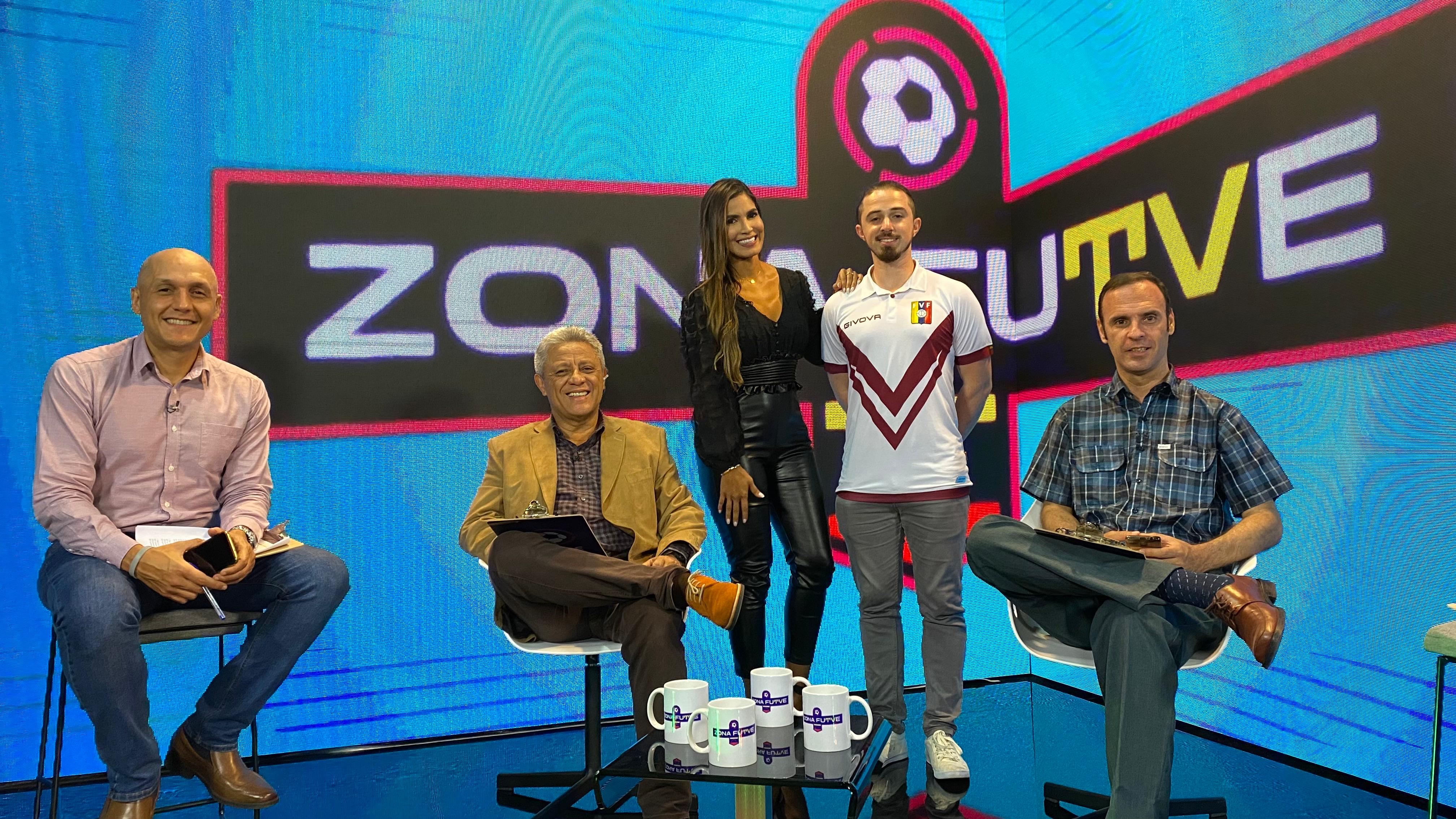
At the time, I’d say football Twitter was at its peak and when I finished writing the book, I set up a Twitter account and then a podcast called FUTVE English dedicated to Venezuelan football coverage in English. Off the back of that account and the book selling fairly well, I started to get contacted by agencies and clubs - particularly clubs in the US and in Scandinavia - asking me about Venezuelan football and wanting to learn about the league and the players. I was able to kind of ‘connect the dots’ but in reverse.
I had clubs and agencies asking me for player recommendations, for guidance on the best academies in Venezuela, connecting with specific people and for a good 2 years, that’s all I did. I basically gave away all the information I had for free. I was just happy to help the Venezuelan football ecosystem and kind of try and find my feet in professional football.
But at some point, I realized I need to try and monetize this. This might be my only opportunity to build a career in football. So in mid-2021, I quit my job in England, me, my wife and my kids moved to Caracas, and my plan was to try and get into Venezuelan football in a professional sense.
"the older I got, I thought getting into football in a professional capacity was passing me by"
[ By the time you saw Venezuela at the U20 World Cup, you’d already been interested in South America for years - why were you so interested? ]
In the past couple years, when I’ve been asked these questions, I realize that so many of the decisions I was taking that led me to where I am now were very much unconscious. Of course, I also made very conscious decisions, like making sure I read at least one book a week or setting a plan for myself when I dropped out of university, but the actual decisions that I was making to try and hit those objectives, I was doing quite unconsciously. If you asked me at the time, I probably wouldn't have been able to answer why. Now I see it more clearly, but still, it was ultimately quite fortuitous.
I think the reason I had an interest in South America is because my granddad was Spanish. He died when I was 10, at a young age, and when he passed away I basically lost contact with his side of the family. Growing up, my granddad was a quiet guy. He didn't speak much, and he didn't do much really. He'd work, he'd get home, he'd just sit in this single armchair in front of the TV and just stay there until work again.
I only ever remember him watching Countdown, a kind of quiz show in England, and football. He’d watch any football that was on TV, but I particularly remember him watching Spanish-language football. I was too young to know if it was La Liga all the time or whether it was South American football as well, but I just remember sitting by his side, with him making awful jokes and little comments on the football.
I think ultimately, when he passed away, through my teens, I saw Spanish language football not only as a way of continuing to enjoy football outside of English football but also as a way of keeping hold of my Spanish roots. And over time, I just preferred it for whatever reason. I can’t really put my finger on it but I just preferred South American football, South American culture, and South American history to Spain. I think it was just because it was so different to European countries - or at least the way history is taught in the UK curriculum.
So, from about 2012 to 2017, I read so many books on South American culture, history and football - but never a book on Venezuelan football, because there wasn’t one! Not in English anyway.
[ Do you (did you?) speak Spanish? ]
Now I speak better Spanish than I've ever done in my life. Living in Venezuela for almost 5 years now, at times I was forced into many all-Spanish situations. The level of English here in Venezuela is low and particularly in football, not many people speak it. There are times when I know that if I’m going to get through this day or week of work, I need to be speaking Spanish.
I did Spanish at secondary school from 11 to 16 but then, honestly, from 16 (2010) to 2017, I didn’t speak a word of Spanish. After 7 years, I still remembered a lot of basic words but in terms of being able to speak with any sentence structure - not at all.
Before going to Venezuela, I tried to refresh myself - like everyone - with Duolingo and I’d always done things like play ProEvo and Football Manager with the language settings set to Spanish. It also helped watching Venezuelan league football, there’s no option with English commentary, so I’d try to listen to the commentary whilst watching games.
But, it’s true what they say, the best way of learning is immersion and literally having to speak the language.
[ When did you decide to write a book about Venezuelan football? ]
It'd always been on my bucket list to write a book. I've always been a massive reader and at school, aside from anything sport-related, English was my favorite subject and I was always writing short stories or poems or whatever.
But I didn’t want to just ‘force the issue’ - if I was ever going to write a book, I needed something to grab my attention and really motivate me. I knew I’d never write fiction but I liked to do a lot of storytelling in my journalism.
In 2019, I was on shared parental leave. Our first daughter had just been born. I'd continued to be obsessed with Venezuelan football. There was never just one moment but one day, one of my best mates for, like, the hundredth time, messaged me, ‘what's going on in Venezuela?’. I think it was around a friendly Venezuela played against the Basque Country in Spain and Juan Guaidó, who at the time was leader of the opposition, was received by the national team after the game, it leaked, and became a hot talking point, not just in Venezuelan football, but in Venezuela in general.
That, alongside an article I’d written for These Football Times that year about that generation - that was the first time I’d written an article on Venezuelan football to an English audience on a well-known platform. People, not just my friends, kept asking me questions about Venezuela and I had a lot more opportunities to write articles about Venezuelan football. A few Venezuelan journalists and fans reached out to me and I kept getting new contacts.
I thought, well, people keep asking me questions about Venezuela. I have lots of material here to write individual articles. I've always wanted to write a book. Maybe I can write a book.
I wanted to use the book as an opportunity to teach people about Venezuela the best I could, but through the lens of football. At that time, I'd probably read anywhere between 7 to 10 books on Venezuela in English, and they were always either outrightly about Chávez or just about the crisis in the country. Besides that, there were a few books on Simón Bolívar from the 1800s. I wanted to give people an opportunity, if I could, to learn about Venezuela through a different lens.
"I wanted to give people an opportunity, if I could, to learn about Venezuela through a different lens"
[ How long did it take you to write the book? ]
I wrote it in a really intense manner, because, like I said, I was on shared parental leave, so, I was writing at all hours based on when my baby was awake. Apart from the 6 months leave, I used up all my annual leave and at the time, I was a shift worker, so I had a week off every 5 weeks and some days off in between.
All in all, I did this for the best part of a year but the actual writing took place between September 2019 and March 2020, just under 6 months. Then, I had a really intensive editing period of 2 months and the book was going out to people in July.
From inception of the idea to the first books in print, was about 15 months. And it was just a really intense project. Again, I set myself targets, initially to write 3,000 words a week but then I broke my arm really badly less than two weeks before I was going to Venezuela and that really set my writing back and I had to adjust the weekly target to 5,000 for a month or two to get back up to speed. My plan had been to drop back down to 3,000 but by the time I was caught up, I was in such a flow of writing that I just kept this pace.
[ Do you think you’ll write a second book? ]
I wouldn't rule it out because I love writing. Even now, I write daily. I keep multiple journals with different themes and obviously, I’m always writing scouting reports as well. I’m always writing something, so I can’t rule out a second book but I certainly have no plans or ideas at the moment.
Each type of writing is different - with my professional writing for example, one of the things I always try and tell people that talk to me about scouting, scouting reports aren’t supposed to be a ‘journalistic endeavor’ - and that’s one of the misleading things about football Twitter, where that line between football journalism and writing for professional reasons within football, whether that’s match analysis or scouting reports or match reports even, the line is blurred. A lot of people, when they start writing scouting reports, because they've taken their first steps into football through this ‘football Twitter lens’, their scouting reports are quite journalistic - quite flowery, very descriptive, but not in an analytical way.
[ Were you running the Twitter account during this time or did that come after the book? ]
No, that was a bit after. Basically, when I finished the book, I kind of had this, ‘what now?’ feeling. Now that I’d written a book, was I just not gonna have anything to do with Venezuelan football anymore? I’d become really fond of it and I was really enjoying it but the games, because of the time difference, would kick off anywhere between 10pm and 2am English time, Thursday through to Sunday. I was like, well, it's not sustainable to keep watching this without a justification! So, I decided to start a Twitter account separate from my personal account, where I can just talk about Venezuelan football in English.
It doubled up as a way of promoting the book but I drew a clear line of division between my personal account, where I did promote the book, of course, and the FUTVE English account. I wasn’t working on FUTVE alone either. It was an idea I came up with and took to one of my ‘online friends’ that I’d met during the process, a guy called Dominic Bisogno who is now a professional, award-winning journalist in his own right but at the time, he was at university and just a very passionate Venezuelan-American who loved Venezuelan football and wanted to channel that in some way.
So, for the whole time FUTVE English was really active, there were two of us.
[ What is so interesting about Venezuelan football? Why should more people be interested or start to follow what’s happening there? ]
I think an easy reason to get interested in Venezuelan football is to look at how well the Venezuelan national teams do at youth level. They almost always get out of the group stages and have reached the quarter-finals, semi-finals and even the final on numerous occasions in the past 15 years, on both the men’s and women’s side. It’s not luck, it didn’t happen just once or twice, it’s sustained. But this success hasn’t translated to the senior level.
For a country of their size, Venezuela’s only ~30 million, it’s not historically a football country and for the last 20 years has been hit by numerous economic crises - why are they doing so well at youth level? And why not at senior level?
For me, one big component (but not the whole answer by itself) is there’s a glass ceiling on how much a Venezuelan football player can develop within Venezuela. There are multiple factors to that as well. One is the quality of the facilities, one is the instability of the football competitions themselves, and one is due to a limited amount of idea sharing within Venezuelan football.
If you look at the development of football tactics and culture through the 1900s, there was a lot of idea sharing in Europe, you had Spanish coaches meeting Italian coaches or French coaches. That’s probably why the UK fell behind, simply by being an island - as football in Europe developed, in the UK it remained 4-4-2, long ball. Venezuela suffers from a lack of idea sharing because it’s the same coaches on ‘recycle’, there aren’t - and haven’t been - a lot of foreign coaches or foreign players bringing new ideas.
This leads to something that sounds very critical but something I actually have a lot of sympathy for, the quality of coaching puts a limit on the development of players. There are some fantastic coaches in Venezuela, but the resources and the setup for them to continue advancing on an individual level without leaving Venezuela is difficult. And then how do you leave in the first place? It’s hard.
So, really, Venezuelan players need to get out of Venezuela almost as soon as they turn 18 to hit their full potential. So many Venezuelan footballers rack up some serious minutes between 16 to 18 but the pathways are a lot harder than for other countries. Look at Iceland, for example, a tiny country, not even half a million people, they had a boom when they qualified for the Euros in 2016 and the World Cup in 2018. They benefit from being part of a European identity that falls under the same rules for transfers. Today, there are Icelandic players all over Europe - they’ve done really well to take advantage of their boom.
Venezuela hasn’t but it could and it should, but it also needs outside buy-in. So, for me, the biggest reason people should be interested in Venezuelan football: there's real talent here, and from a business point of view it's still an undervalued market. It just needs more patience because when you’re signing a young Venezuelan, often, they're leaving Venezuela for the first time in their life - or, if they’ve played for the national team, maybe the second or third time.
"there's real talent here, and from a business point of view it's still an undervalued market"
[ You’re scouting for Phoenix Rising - did you see joining a professional club as an important ‘milestone’ in your career? ]
For me, it's the proudest moment of my professional life by a mile. I'd always wanted to work clubside. I'd been consulting for agencies for two and a half years and I knew that I didn't want to stay in agency all my life. There’s a lot of business in agencies that I don’t really care for. I love football, I don’t love business. I also just value simple things like stability of income for my family and a lot of agency work is heavily commission based.
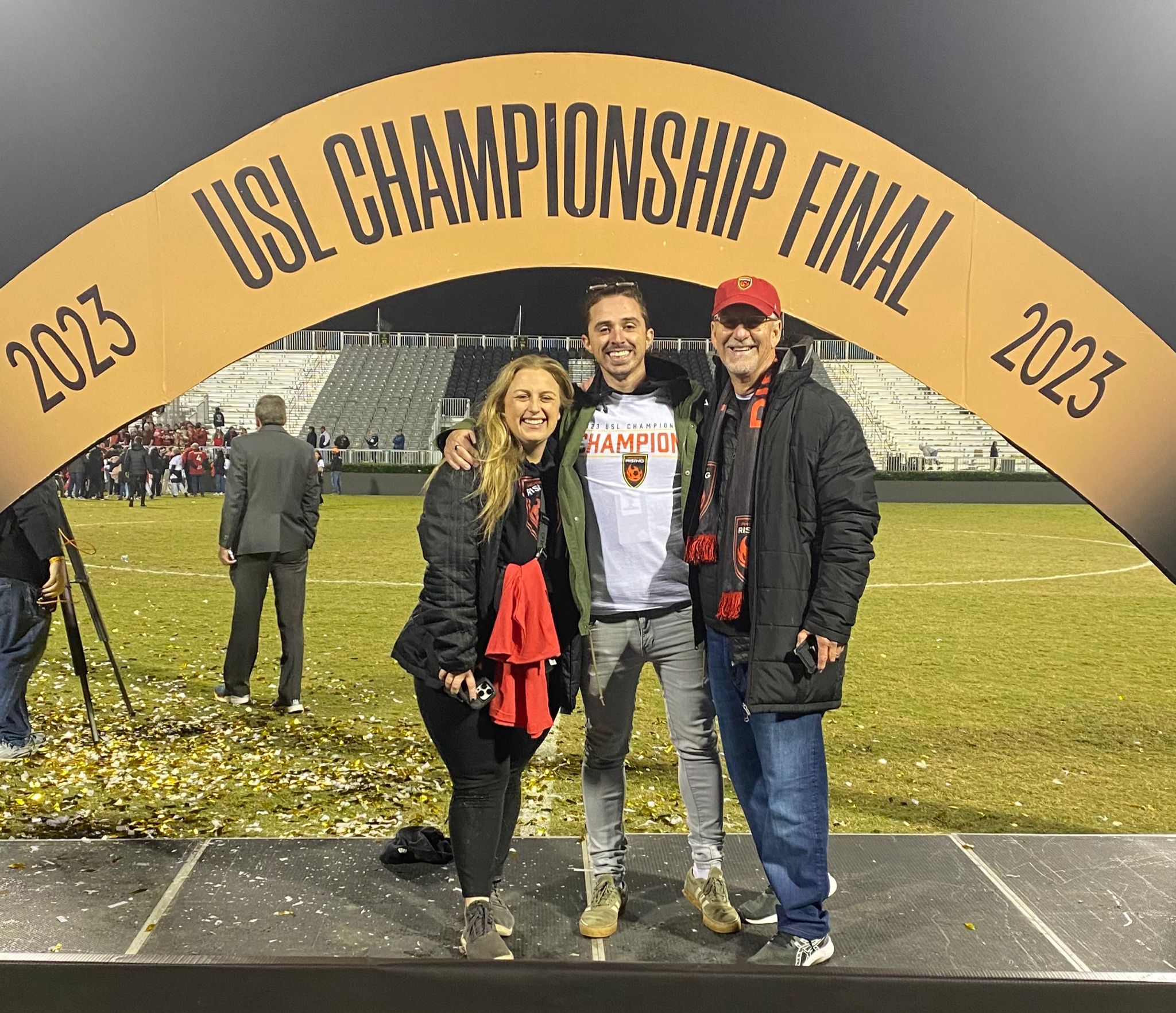
After over two years in Venezuela making next to nothing, having left a good job and situation in the UK, I was beginning to feel like I’d made a mistake. My work caught the attention of the sporting director of Phoenix Rising, Brandon McCarthy, and I’ve been there nearly 3 years now.
Brandon allowed me, in one way or another, the first year, or maybe even the first year and a half to literally just grow on the job and learn. When I joined, my title was ‘scouting consultant’, I didn’t have any explicitly written objectives, Brandon just wanted me involved in the club and involved in the project - he believed in the value of what I was doing.
Very early on, I learned a lot from Stephen Drennan, a phenomenal data analyst. He’d been very active in the football Twitter peak years under a different username. His background was as a financial advisor, he’s worked with numbers and analytics his whole life. He’s a really patient and thorough educator, and I was so happy to just learn from him and supplement the learning I was doing myself.
Initially, when I came to the club, I came with quite a vast network of contacts not just in Venezuela, but increasingly globally. At the time, our head coach was Venezuelan and we had 4 or 5 Venezuelan players. So, that was the direction the project was going, but, football’s football and that changed very quickly. After he won the league during my first year with the club, head coach Juan Guerra, left for the MLS to be an assistant at Houston Dynamo and our Venezuelan players moved on. For numerous reasons, it's been hard to recruit from Venezuela since, but my skillset is versatile and while Venezuela is where I am based and grounded my scouting work, it’s not a limit. Having a strong, deep knowledge of several leagues - particularly ones with different strengths and traits - has given me an anchor-point from which I’ve been able to quickly grasp the compatibility of other markets for the USL Championship. I think that shows in our recruitment, too.
At the start of January 2025, I became Chief Scout.
[ Does being a USL team, without the possibility of promotion, feel limiting in some way? ]
USL from 2028 is penned to be a promotion relegation three-tier system. So in terms of the football pyramid, the top division of the USL, which I believe will be called the USL Premier, will sit alongside the MLS. Obviously, there will be no promotion and relegation into the MLS, but in terms of the pyramid, it will be Tier 1 of the US soccer pyramid, alongside MLS, and then the second and third levels of USL will be Tier 2 and 3 and there'll be promotion and relegation between those three divisions.
I'm really looking forward to that but, we've got two more seasons to get through first. I’m excited about what it will mean for us as a club, the US soccer landscape and the setup in general. I was more attuned to it having experienced Venezuelan football than I would have been if I made the jump straight from an English football background to a US football background because it’s not only an absence of promotion- relegation, it’s also the two conferences, the playoff structure, the team that finishes top of the table not necessarily being league winners - but you learn to appreciate it.
[ Do you think your more ‘generalist’ background before becoming a scout has benefitted you (especially vs ‘career scouts’)? ]
I used to hate being asked this because I don’t want anyone to feel like I have the answer and I don’t want anyone to copy me because the decisions I took were so strange that it’s not advice you can give to another person. It would be super irresponsible of me to say, oh yeah, move country with your wife and kids, to chuck yourself into that league and immerse yourself into that world.
Sometimes people reach out to ask me about things because they follow a niche league - and Venezuela is a niche league - so I might have somebody contact me saying they’re really into the league in Uzbekistan, do I recommend that they move out there? I don’t know! I don’t even know who you are for a start. Like, I’m really happy to have these conversations but it would be irresponsible of me to say, yeah, do that, it worked for me. I think things worked out for me for a multitude of reasons, not any one thing.
In terms of having a generalist background, I do think that's important, but ultimately I would describe my skillset and approach to scouting as versatile rather than generalist, and I’ve always put a big onus on due diligence and depth of research. I’d say if you’re somebody who loves football, and generally consumes a big amount of it, that's a solid foundation. But next, what transferable skills do you have from other jobs? I think a lot of people overlook this and don’t realize how their skills are relevant - like Stephen is fantastic at his job because he has a very good understanding of football but also because of his analytical background and experience in risk assessment from his time as a financial advisor are hugely transferable skills. Someone with the same background might not realize this, or might not have a boss who empowers these skills.
Brandon is a very empowering leader and manager and he made it very clear that I had skills outside of football - or skills that weren’t directly attributed to scouting - that were going to bring value and empowered me to harness them. For example, I was a behavioral analyst for 6 years. I never thought that that would benefit me in professional football, but actually it helps me as a scout being very comprehensive and thorough - obsessive even - when I’m doing due diligence on players. I would always advise people to see how they can use their skills and knowledge in football to make themselves more well rounded and valuable.
"I would always advise people to see how they can use their skills and knowledge in football to make themselves more well rounded and valuable"