The 21st century has seen a shift in the pathway into top level coaching. A long - and often high-profile - playing career is no longer the only route. Coaches like José Mourinho, Maurizio Sarri and Julian Nagelsmann have reshaped assumptions and proved that a sparkling playing career is not a requirement to coach effectively at the highest levels, leading to a new generation of expert coaches.
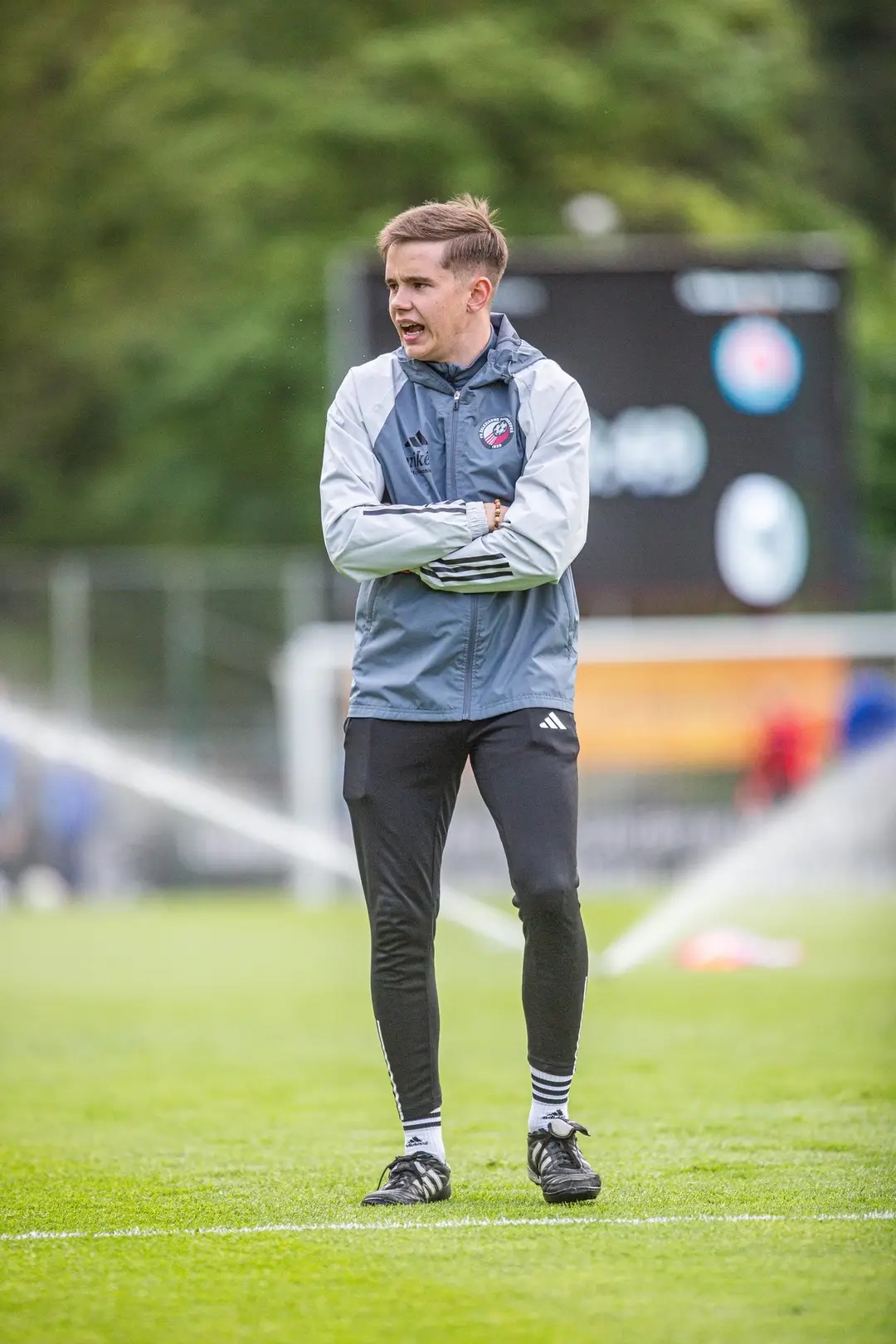
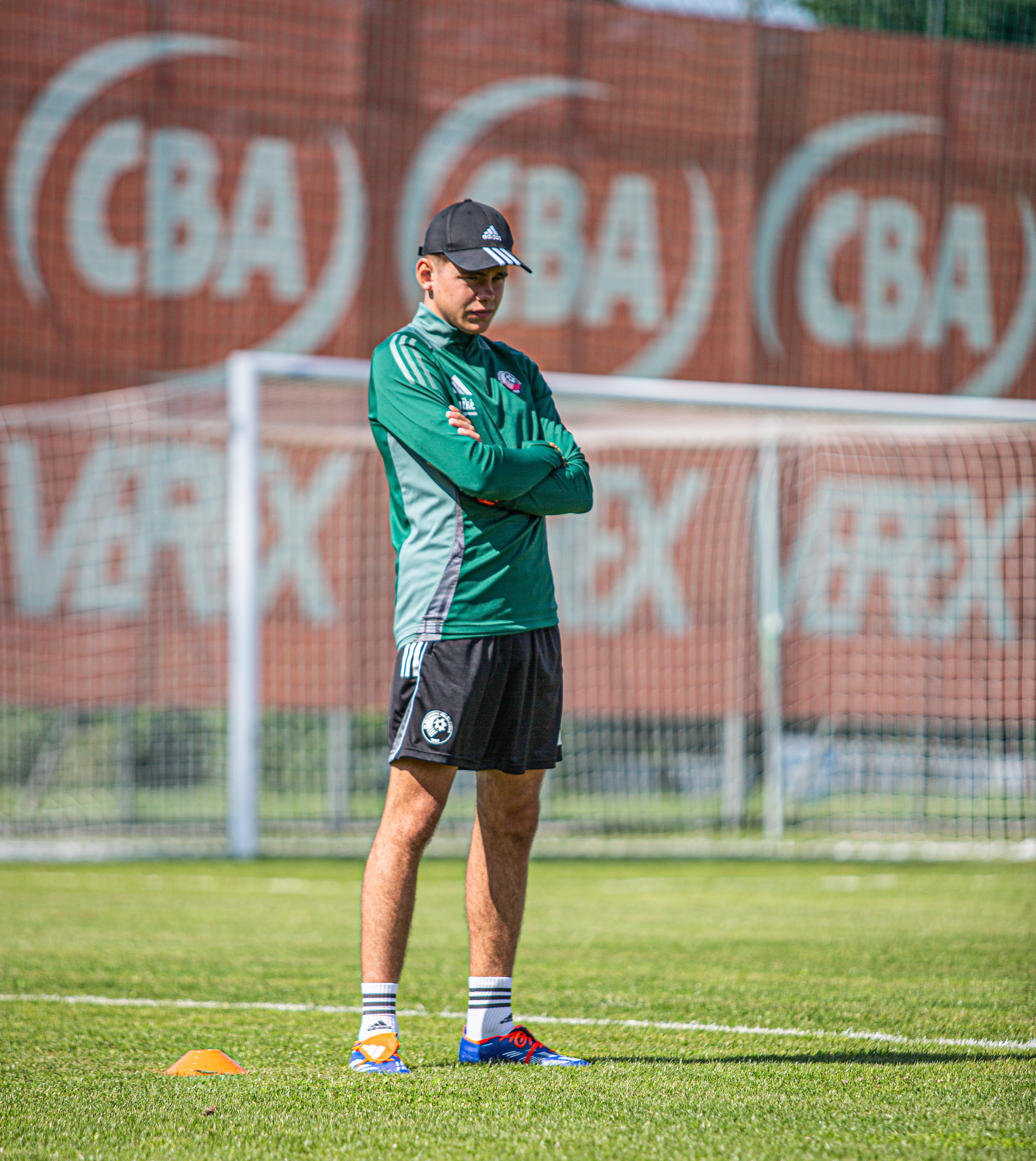
Dominic Rajna is part of this talented new generation of coaches. Just 20 years old, he’s already achieved some impressive milestones, including stints in the top divisions in Denmark and Slovakia and the UEFA A License - still, he has ambitions for much more.
In this interview, Dominic shares his journey - including the challenges - as a young coach at the highest levels, reflects on how the game is changing and what he’s had to give up to find his way in the game.
The interview has been condensed and lightly edited for grammar and clarity.
[ Getting into coaching ]
I started playing and coaching at a similar age. I started playing around 9 or 10 and coaching at 12. I was just coaching young kids for fun at the start, mostly just volunteer work for community service hours.
I would say, when I was around 15, that’s when I started getting really passionate about coaching and started seeing it as the thing I wanted to do going forward. I was coaching kids maybe 3 years younger than me in the Sigma Academy as an assistant, which is one of the better academies in Canada. I was also working as an analyst with the first team, which is in League One Ontario, which you could maybe call the second division in Canada.
When I was 16, I got the head coaching role with the under-15 boys team and took on an assistant role with the League One team. Then, what happened was, the head coach got a red card, and I was able to step in as a head coach. Which was really cool. Obviously, as a young guy, and you're coaching guys who are 30 years old, and things like that!
It was a really special moment for me, and I still reflect on it, because it was such an important moment in my coaching career, in terms of learning. We were winning 2-1 at halftime, and then I did this crazy data analysis on which intervals of the match they were strong in, where they could be threatening, and all these kinds of things, and I saw that between the 45-60 minute, they were by far the strongest team in the league. So I changed formation (4-3-3 → 5-4-1) and that was probably the worst decision because we’d never trained in a 5-4-1. It was obviously difficult for the players to adapt and we conceded twice - well, my data proved right, they were quite good in that interval!
[ Vancouver FC, FC Midtjylland and Podbrezova ]
After that match, I started to get a lot of attention and media recognition in the Canadian landscape and this opened a lot of doors for me. In the winter, I got the opportunity to join Afshin’s staff in Vancouver (in the Canadian Premier League). He’s become my biggest mentor and my biggest guide. It was a privilege to work with him because it was the best environment I could have gone into. He taught me the most about football in a very holistic way - not just technical, tactical, whatever, where maybe Canadian coaches are strong but the international coaches have experienced the psychological aspect of players, of managing teams, that’s where Afshin is on a different level compared to Canadian coaches. I really enjoyed my time there and we’re still in touch weekly or bi-weekly.
After several months with Afshin, I got the opportunity to move to FC Midtjylland to work as an individual coach there, which was fantastic. Obviously, he was frustrated at the time. I realized that loyalty is key - if you have a contract, try to keep to the contract because that’s how you gain trust from people and develop really strong relationships. That’s something that I’m looking at now, going into my next role, it has to be one where I’m going to commit 120% and not back out of it.
At FC Midtjylland, I got the opportunity to work in a very unique and innovative way of working. I learned a lot there about how objective knowledge is really important. After several months at Midtjylland, I got the opportunity in Slovakia with my agent. My agent was connected with the assistant general manager at Podbrezova, they were looking specifically for a young guy from Midtjylland, Nordsjælland and these kinds of clubs, so it linked quite well.
In this opportunity, I got a lot of space to share my ideas, to work on things day in and day. I also got to take on responsibility with the first team, especially after the head coach also accepted a role to work with the under-21 Slovak national team. As the first assistant, I led training and matches during the international breaks. That’s a huge experience as a young guy to have, a huge role and responsibility and I learned a lot.
[ How were you as a player? ]
When I was 14 or 15, I had a major injury, a one-year injury where I tore my LCL. It was a minor tear, but there was some nerve damage, and during my recovery, I developed a kind of syndrome called Complex Regional Pain Syndrome (CRPS) which I’m still dealing with to this day.
So, that’s why I stopped playing, but, to be honest, it was already a mix of that and wanting to get into coaching.
I was a center back and a number 6 and I was always thinking about the game from a tactical sense. Like, I wasn't really thinking, what's my next action gonna be? I was thinking, how are we gonna beat this opponent's mid-block? I was always ‘coach thinking’. It was a little mental.
I remember telling this to my dad, and he’s like, what?! I’m paying like 4 grand a year (because of pay to play in Canada) for you to play football and you're telling me that you're thinking about football from a ‘coach's lens’? Then I went into volunteering at first, which was very difficult in terms of family relationships. You know, they’ve spent a lot of money for you to play football, invested a lot for you to maybe get a university scholarship or whatever it may be and then you’re saying you want to end and want to volunteer for free! Meanwhile, I didn’t have my driver’s license yet and my dad had to drive me there, 30 minutes away and wait for 3-4 hours while I did training sessions - it got a lot easier once I got my driver’s license.
[ How did you convince the club, Sigma, to take you on as a coach at such a young age? ]
I think it was kind of clear to them, from a young age, that I'm quite tactical, and I'm thinking about these things. It would be funny if I found the message now, when I reached out, it was in a very open way with a long message that showed vulnerability and humility. I wanted to learn and grow and be in the environment of a top youth program in Canada. I want to grow to a top, top level. That was the goal.
I mean, when you’re watching football all the time, every weekend, you’re driving your parents crazy because you’re watching like 6 matches on a Saturday or you’re waking up at 6am to watch a game. And I wasn’t ‘just’ watching, I was doing expected lineups, thinking about what system the teams would play and doing my own analysis.
The beauty of it is, when you’re thinking like that, and there’s so obviously a clear desire to coach, it's more intuition. When people ask what got me into coaching, it was intuition. Many of these young coaches that have been coaching for a long time, Nagelsmann, Matthias Jaissle, so many of these young and nerdy guys - ‘computer coaches’ some call it - knew this was right for them even before they started coaching, they had this intuition.
[ You’ve been working at the first-team level for several years already. Have you faced any difficulties with players, or even staff, due to your age/experience? ]
With the staff, it’s very easy. If you have quality, the staff will see it, so that's quite easy. The only thing that does come there is sometimes a sort of jealous component, like, what the hell? When I was 20, I was drinking beers and hanging out with girls and things like that. I’ve seen that component a few times but I always take it with humility. There’s nothing to be jealous of, I’m still a long way from where I want to go.
In terms of the player perspective, to be honest, I've had worse experiences with the guys that are closer to my age than the older ones in their 30s. The older players usually see quality quite fast and they’re on board right away. For the younger guys, it’s often quite different to what they’re used to and maybe are more looking for opportunities to take advantage if they can. I’ve had to have really strict boundaries. It’s quite interesting because you would think it’s the opposite way around, to be honest.
I started working with a leadership coach and I’ve learned a lot from studying psychology but the key is to have clear expectations and set clear borders.
[ You’ve completed an amazing number of qualifications for a coach at your age! ]
Yeah, I started the UEFA licenses with the C in Scotland and went all the way to A. In Canada, I did the C and B licences and some courses in America called the Premier Diploma, which was quite good. I’ve also taken a lot of courses from Raymond Verheijen, including a Master’s in Tactical Periodization, a really intense but enjoyable year-long course.
I’m currently studying a Bachelor of Arts in Psychology and have done a bunch of short courses as well on different psychology stuff, sleep science and more physical or anatomy type courses.
I try to be very diverse in what I look at and what I'm interested in because I know the modern manager has to be very diverse in their knowledge, and has to know a lot about everything. If you don’t, you're gonna get caught out really fast and to be honest, you will just look stupid.
So, in terms of courses and education, I try to get as much as possible. I’m humble and I know I’m going to be learning every day of my life.
"the modern manager has to be very diverse in their knowledge, and has to know a lot about everything"
[ You mentioned an agent, how does a young coach get an agent? How important is an agent in finding the next job - or the best job? ]
We got in touch when I was in Vancouver. At that point, I had a lot of agents reach out to me from big agencies, and, to be honest, I got a recommendation from my dad to make sure you're not going to be a small fish in a big pond. And I was kind of worried about that. That’s why I reached out to Ryan.
He's perfect for me in the sense that we're really relatable, and it's a smaller agency, but an agency where Ryan and I keep in touch almost daily, and you can really feel that he cares for you, and that's, I think, the most important part of it.
Most agents nowadays will also represent coaches, that’s changed a lot from when I first started a coach - I think there were a lot less, in terms of percentage, coaches worldwide that had agents. I think it’s just something that I needed when I was alone in Europe on this crazy journey at a young age to move from Toronto to Vancouver and then to Denmark and Slovakia - there are a lot of hurdles along the way and it’s definitely helpful to have someone helping you with these and obviously to find the next possibility in your coaching journey, the same for players.
[ How is coaching changing? What are some of the next trends? ]
Now there's a really clear trend. Clubs are moving away from these kinds of ‘system’ or ‘philosophy’ coaches. Coaches that really understand the culture of the club, the people and players and staff in the club, their heritage, their history - where they’ve been successful and where they haven’t - are the ones that are more successful.
There are a lot of examples right now, you have Wilfried Nancy, Ruben Amorim, Thomas Frank - all very clear examples. These guys all have their set systems for how they want to do things and have all really struggled.
I spoke with Deven Rashed, a Swedish coach educator, about the question where your football ideas as a coach should come in? And it's probably only the 6th or 7th step, really. There are so many things that come before implementing your own ideas, and those ideas should be so limited.
Now, when coaches come in, they have almost unlimited data they get to look at. This data should be useful because you can find trends in the data. Let's say this team was winning when the average height of their defensive line within the match was 50 meters but when they were 10 meters higher up the pitch, when their average line was 60 meters, they lost. Maybe then, you should speak about being really good in the mid-block and how the team should be good in the mid-block. When you come in as a coach, you look at this, you see what happened in the past, analyze it and then based on that, you implement your ideas and what you want to see from the team. To be honest, there are so many situations where 1+1=2, but many coaches overcomplicate their ideas.
Look at Manchester United, why is Michael Carrick successful right now? Obviously, three matches and that could fail really fast but at least he understands the surroundings and that’s why players buy in immediately. With your own ideas, you have no idea the likelihood that they will buy in - they could, they might not. With Ruben Amorim, he has this 3-4-3 DNA that he didn’t budge from and immediately he had the press and everybody saying, ‘Manchester United is a 4 at the back team’ and that gets into the minds of the players and impacts performance and confidence.
That's why it's important to go from culture, to go from the team and the badge first. Understand that, understand where they're at, understand their history, and then build your ideas from there.
"Coaches that really understand the culture of the club ... are the ones that are more successful"
[ Do you think we will see a return to ‘vibes based coaching’ (perhaps with Zidane and Ancelotti as the gold standard archetypes), where the main priority is ‘man management’ and simply creating a harmonious dressing room or is this too simplified? ]
Well, there's a reason I'm studying psychology non-stop. I want to be a young manager, I don't want to be a young coach. The reason that's my vision, the reason it's not to be a young coach is because I know the trend's happening. Definitely, this kind of distance from players is going to become more and more important because of the way society is evolving. I took a walk and I saw 8-year-olds with iPhone 16s! Three of them right beside each other in the middle of the sidewalk, nobody’s looking up at all, just looking at their phones. It's unbelievable, and that's the way society is evolving.
So, then it's, how can these people be coached? How can these people be educated? I mean, their attention span is zero. They always need some sort of stimuli, so for coaches, the question is how do they create their own stimuli?
And that's for them to find the right situations, the right spaces to be in on the pitch, and these kinds of things. It’s like the debate with Mbappé, do you coach Mbappé? I mean, you shouldn’t really be coaching him - he’s just going to run in behind, he has very good timing, very good execution of the run, all these things he has at a top level, so why should you be coaching him to do something else?
These are the kinds of things, maybe I'm gonna get some stick for going on about this, but I mean, some things are very clear to be seen. It’s not like I’m saying anything revolutionary now.
There are so many coaches like David Moyes or Sean Dyche, these are, let’s say, ‘old-school’ English coaches who are having success right now. And to be fair, they've had success in the past, it's not like they're just having success now, but look at how sustainable their success is!
[ What is a problem in football that bothers you and you think needs to be solved? ]
Staff and data.
How a staff is created is horrendous worldwide. It’s all just individuals! The sporting director wonders, ‘is this assistant going to click with the head coach?’ oh, he didn’t click? Well, we don’t know what to do with him but he’s on €8,000/month - it’s the biggest problem in football.
There’s not enough research on staff and what is actually considered a good staff member. For players, there are tons of KPIs and analysis about how they might fit into your team but with staff, at best, you can get references - but in terms of actual on and off-pitch performance, it’s going to be very difficult.
One of my goals in these past 5 weeks has been assembling a shortlist for a future staff. I’d have 6 positions - an assistant, a coach analyst, a data analyst, a goalkeeper coach, a physical consultant and a recovery consultant - so 6 people. For these 6 positions, I have around 50-60 guys, around 10 per position with the very top people listed at the top.
But you also have to understand, depending on which project you go into, whether they'd be interested, if they're under contract, or if it’s the right fit. It’s a question of networking, but also putting it on paper and sorting it out.
The second thing is just data. Data's misused. There's a lot of money going into data, but it's still being misused in the sense that we're just looking at things like xG and progressive passes, but these things don’t help a coach.
There's a lot more impactful data that's a little bit more custom, that's more difficult to find, that's potentially even manually done and that’s going to take time to discover how to use it in the best way. But ideally, data can be the center point your coaching philosophy revolves around. Today’s data is just not useful in this way.
[ You mentioned some older coaches feeling some resentment towards you - do you ever feel like you’re missing out on things that a ‘normal’ 20-year old experiences? How do you think about these trade-offs? ]
I’ve missed a lot of things. I missed prom because I was in Scotland for my UEFA license. There have been so many things, but I always have the end goal in mind. When you have the end goal as a reference, it’s very easy to stay motivated day in and day out.
To be honest, I’ve completely forgotten about those things. I completely forgot that 20-year olds are having parties right now. On Friday and Saturday evening, I’m probably reading a book or - like now (Dominic holds up a stack of papers) - in front of this monitor doing manual data analysis.
For me, this is my love, this is my passion. It’s always with the end goal in mind and reverse engineering from there. I realize that this is the journey and this is what I’m part of, I have to enjoy every step of the way.
"this is my love, this is my passion"
[ I saw your post about how much you’re enjoying this time without a job and working on some new things. In terms of your return to coaching and professional football, what are you looking for? What is the right opportunity/environment/challenge? ]
So, I finished with Podbrezova in December, so it’s been about 5 weeks that I've been without a club. Over this time, there have been a lot of inquiries from me going out, but also people coming towards me. I’ve already declined a lot.
I'm very specific in terms of the next role and what it has to be. It has to be with the right people, and it has to be where I'm in a role where I have a lot of responsibility, and I can work 16 hours a day if I want to - in the sense that there's enough work to be done and I can evolve as a coach, and more importantly, grow as a person.
Currently, I am ‘linked’ with 3 head coaches, where if they get a job, then I’ll go with them as an assistant. We’re in close contact all the time and in touch at least weekly. If there’s an inquiry, I jump on it right away and help out with research on the club. I’m also looking into several projects that look very interesting, one in Estonia, one in Sweden, for example.
I'm also working on a project that’s basically a club - or project - proposal. It’s very much aligned to what I was speaking about earlier - it’s about understanding a club first, getting all the information about a club, the players, the staff, the infrastructure, the resources, everything and from there building a plan for the club. The specific club is irrelevant because it’s a project proposal in the sense that I want to propose what I would do with any club that I go to in the future. I’m working probably around 12 to 16 hours a day, together with two others, and it’s going to have around 500 slides.
This will hopefully help me in the future and give me a clear reference on what I want to create for clubs.