The thing about football being the world’s most played sport is that it can take you anywhere - often to places you’d never expect.
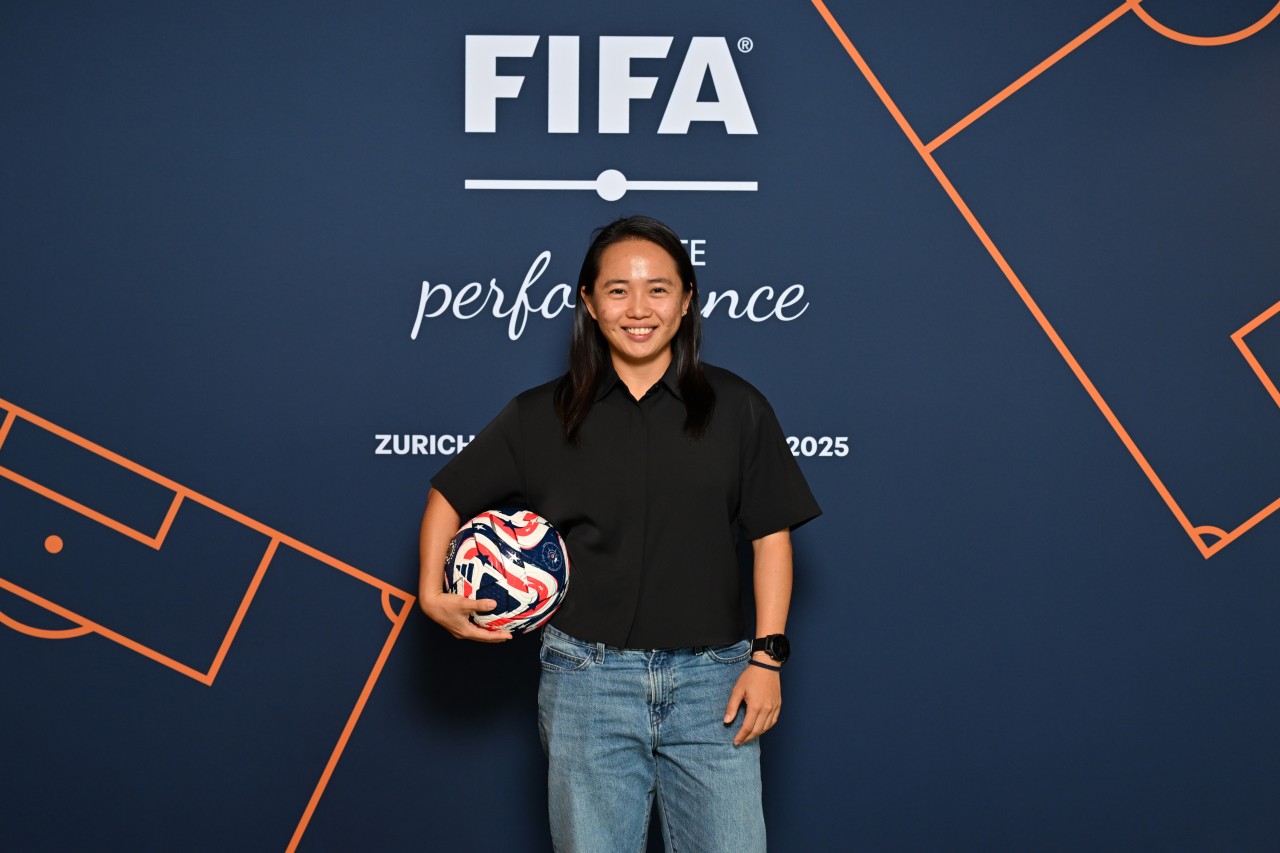
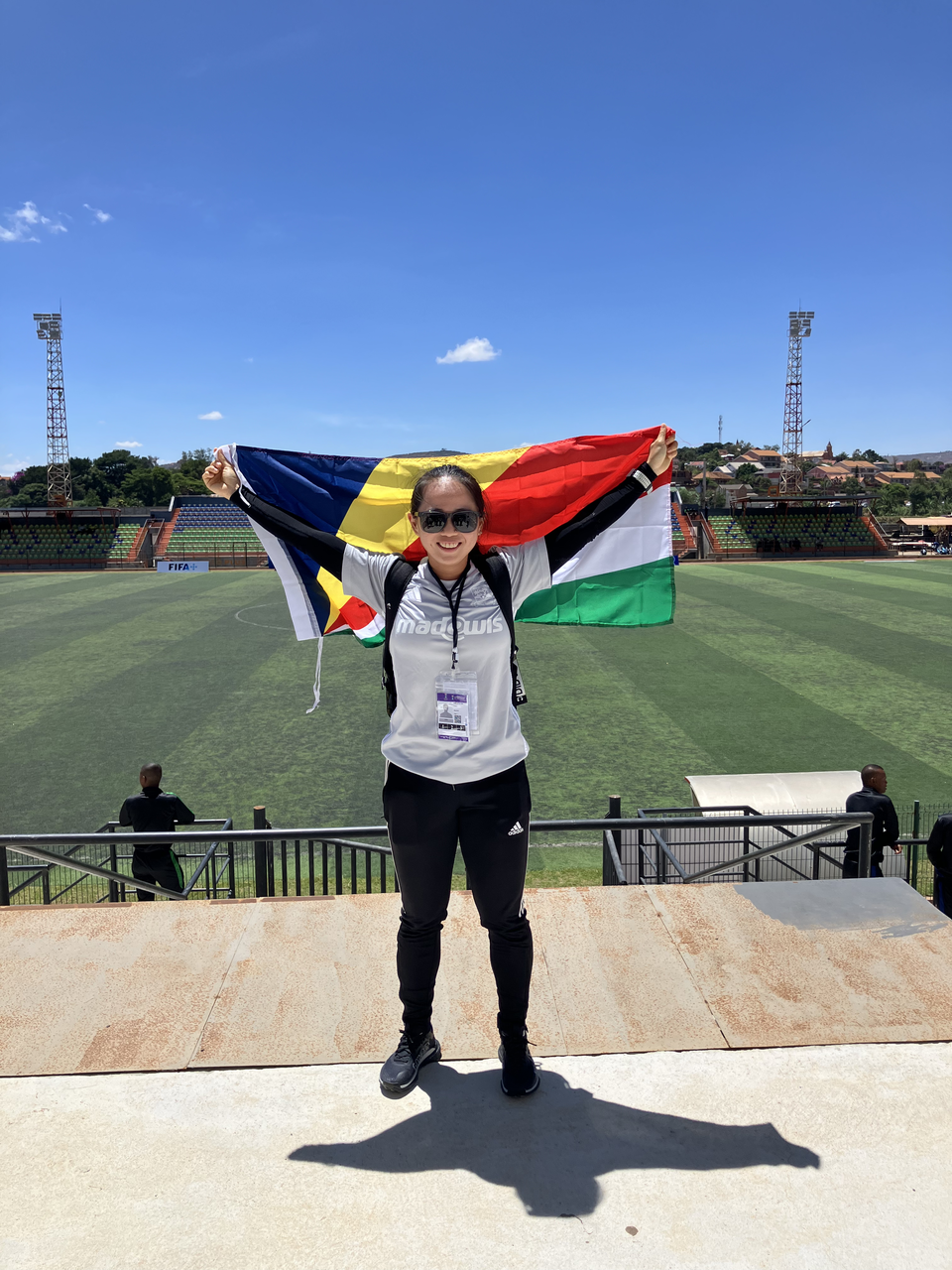
For Chris Yip-Au, a former Singapore international, that meant moving over 5,000km to take on a role unlike most in the game. Since 2023, she has been Head of Women’s Football and Head Coach of the Women’s National Team in Seychelles - a position that goes far beyond the touchline.
In this interview, Chris shares the reality: the job is much bigger than coaching. She is building the foundations of the women’s game in Seychelles - from grassroots participation to league structures and international pathways - often with limited resources and support.
The interview has been condensed and lightly edited for grammar and clarity.
[ How did you get into football? ]
When I was in secondary school, everyone needed to do a co-curricular activity - something outside of school and studying. I really wanted to join a sports team and I was aiming for basketball or track and field but my school didn’t have those options! But they had football for girls and I guess that was the next best thing, so I jumped into it.
[ You had a pretty successful playing career! ]
Oh, well, I wouldn't say I had a very successful playing career! But it was quite a journey. About one year after I joined the school football team, I was scouted to play for the under 16 national team. That was the first time I realized that actually, sport can be so serious! When you’re like 13 or 14 years old, you’re just playing for fun and at that time there were almost no professional players in women’s football, so I didn’t think about going down that path.
Once I got into the under 16 team, we got to travel for matches and as a kid especially, traveling is exciting, and I realized that I could actually be good at this and started putting in the effort and work to become a better player.
After the under 16s I joined a football club that was playing in the women’s league at that point in time but after one season with them, I felt like I wasn’t growing and I left and joined the team that my school coach was playing for. And that has been my team ever since. Before coming to Seychelles, I was coaching them in the league. It was a special moment for me because I was a player and I transitioned into being the coach. Kinda a full circle moment. Right now, even though I am miles away, I regularly keep up with the updates and news. From player to coach to fan.
I played for my junior college and my university team - and when I was playing in university, I was also playing for the national team. Unfortunately, at that point in time, women’s football in Singapore wasn’t really a priority, so we didn’t get a lot of playing opportunities.
In 2016, I went through a period where I felt very burnt out from balancing uni, football and coaching and I went to visit a friend in London. We had a kickabout at Regent’s Park and somehow Charlton Athletic saw that I was in London, watched some of my playing videos and invited me for a trial. I never thought I could be scouted like that! Unfortunately I didn’t take it because I still had my last year of university and just wanted to get it over and done with. But yeah, there’s always been that question in the back of my head wondering if I made that jump, maybe I’d have a different path. Maybe at one point in time, I felt that was one of my regrets.
After university, I wasn’t sure if I wanted to continue playing football because Singapore is a place where education and career really matters. Once you’re out of the school system, you have all the adulting to do, all the bills to pay and have to plan for your future. As a fresh grad, I had the opportunity to go to Australia and play. I felt because I’d missed out on the Charlton Athletic opportunity, I had to take it and I played for 6 months and got to tick that off my bucket list.
While I was playing, I was coaching and working with the youth national teams, from the under 14s all the way to the under 19s. I think it was one of the ways where I felt like I could give back to the game. But after a while, I felt like it was taking a toll on my body because I was on the pitch coaching and then training with the senior team afterwards and my legs couldn’t really recover. So, at that point, I kind of knew I had to make a decision whether to continue playing or coaching.
"I realized that I could actually be good at this and started putting in the effort and work to become a better player"
[ You studied engineering from one of the top universities in Singapore - I can’t imagine football is a common career path amongst your peers - when did you decide that you could/would pursue a career in football? ]
I think there wasn't a single reason but one would be, I was doing an internship in America over the summer at Clemson University and I was spending a lot of time in the lab and I was like, oh my god, this is so boring! I realized that I didn’t want to do that.
Then, of course, I was fortunate enough to have a coach as my role model. My secondary school coach, at that point, was coaching full time and I realized that this could be a full time job. So, when I graduated university, I just continued doing what I was doing but in a more full time manner.
[ What did your friends and family say? ]
I think for my mum, she just wanted me to have a degree, something to fall back on in case it didn’t work out with football. So once I graduated, she was okay for me to decide however I wanted.
But I think my friends were a bit worried and wondering what are the prospects for progression in football. Because in a corporate structure, it’s very clear that you can grow over time, get promoted and you know where you will end up. But as a football coach, you’re just a football coach, in 10 years, in 20 years, my title will still be the same, ‘football coach’. Coming from a culture where we always focus on academics and careers, some people couldn’t understand this.
Even when I went back to coach my secondary school team, the coach of the boys’ team - he was slightly older and a very nice man, very caring - he was always telling me, ‘football is something you can do later, you’re young, you should be focusing on your career first’. Initially, it was just background noise but sometimes when many people say something, it kind of gets to you. So, I don’t want to say I wavered a bit but I mean there were, of course, doubts - especially in the time when I was struggling a bit with my work and the environment not being quite what I’d hoped for. But sometimes life works in mysterious ways and every time when I want to give up, a new opportunity comes up and I always take that as a sign that this coaching thing is my thing.
[ How did you get the opportunity to take over the Seychelles national team? ]
So, my friend actually held this role and was offered the job with the Fiji women’s national team. When she left, she recommended that I apply for it - I thought, why not, it’s just an application, they might accept me, they might not, so I applied and I got it and that’s how I ended up here.
[ How would you describe the current situation in Seychelles for women’s football? ]
So, Seychelles’ population is only about 100,000 people, and it’s spread across 3 main islands, and if we talk about the number of girls playing football, it’s only about 300. Of course, with a talent pool of ~300, it’s very difficult to build a good national team and as a result, we struggle a lot with quality.
Right now, our main focus is trying to get more and more girls playing football and grow this talent pool over time. I’ve been trying to find ways to make it more attractive for girls to play football.
There are also a lot of other, limiting factors to growing the game. One, of course, are perceptions - although we’re in the 21st century, some people still don’t think girls should play football. It’s a small island and there are a lot of social issues as well - alcohol and drug problems and teenage pregnancy. That’s very tough and battling all of that, at times it’s like we’re building an at-risk youth program more than a national football program.
"our main focus is trying to get more and more girls playing football and grow this talent pool over time"
[ You’re the only full time employee on the women’s side in Seychelles, what are some of your responsibilities outside of actually coaching the team? ]
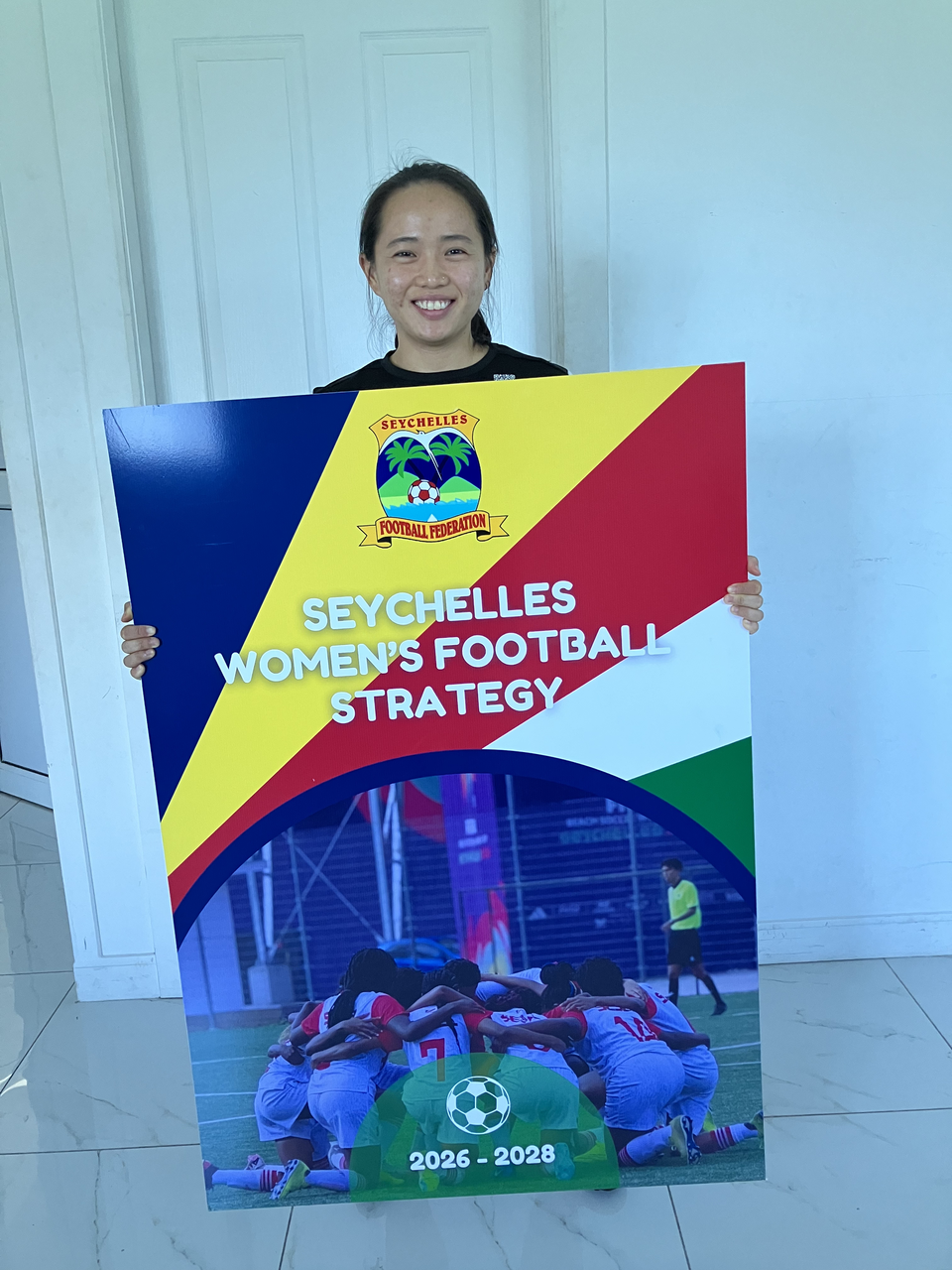
My full job title is Head of Women's Football and Women's National Team Coach, which are two different jobs entirely. When I’m not coaching, I’m trying to find ways to grow the sport here in Seychelles, from managing the youth teams and trying to organize programs like the school leagues and the women’s league. Recently, we launched a new strategy for the next 3 years for women’s football in Seychelles as well.
We don't really have a lot of staff available, so a lot of times I have to set up the pitches on my own. For the women’s league, you have to make sure that the changing rooms are clean, the goal posts are there, the lines are marked, and so on. For the school competition, because it’s held at a different stadium in town, you have to bring the water from the Federation and drive it into town before marking the playing field and setting everything up.
These are some of the things I do - and it requires a lot of manual labor. Before I came here, I didn’t have a lot of upper body strength - like most footballers - so I had to go to the gym and make sure that I’m strong enough to carry all these things! Because sometimes, if it is not you doing it, things won’t move.
I’m more and more involved in helping players to play abroad. When I came here, we talked about the talent pool. There are not too many girls playing but sometimes, out of 300, you get one player who is really good and you see the potential she has. Of course, being on the island really restricts them and those talented players should not be limited. So, in the short term, I kind of pivoted from building a strong national team to seeing if I could influence maybe one, two, or three players to build real careers abroad as a short term plan while I’m building a sustainable women’s pathway here.
With these kinds of international moves, you really need to know a lot of people - at the beginning, when I was very new in my job, all my contacts were in the Asian region and, of course, Seychelles is in the African region, so it’s been a bit difficult. There’s lots of reaching out and pitching to people, trying to get players set up for trials, etc - acting as an “agent” has become one of the many hats that I wear.
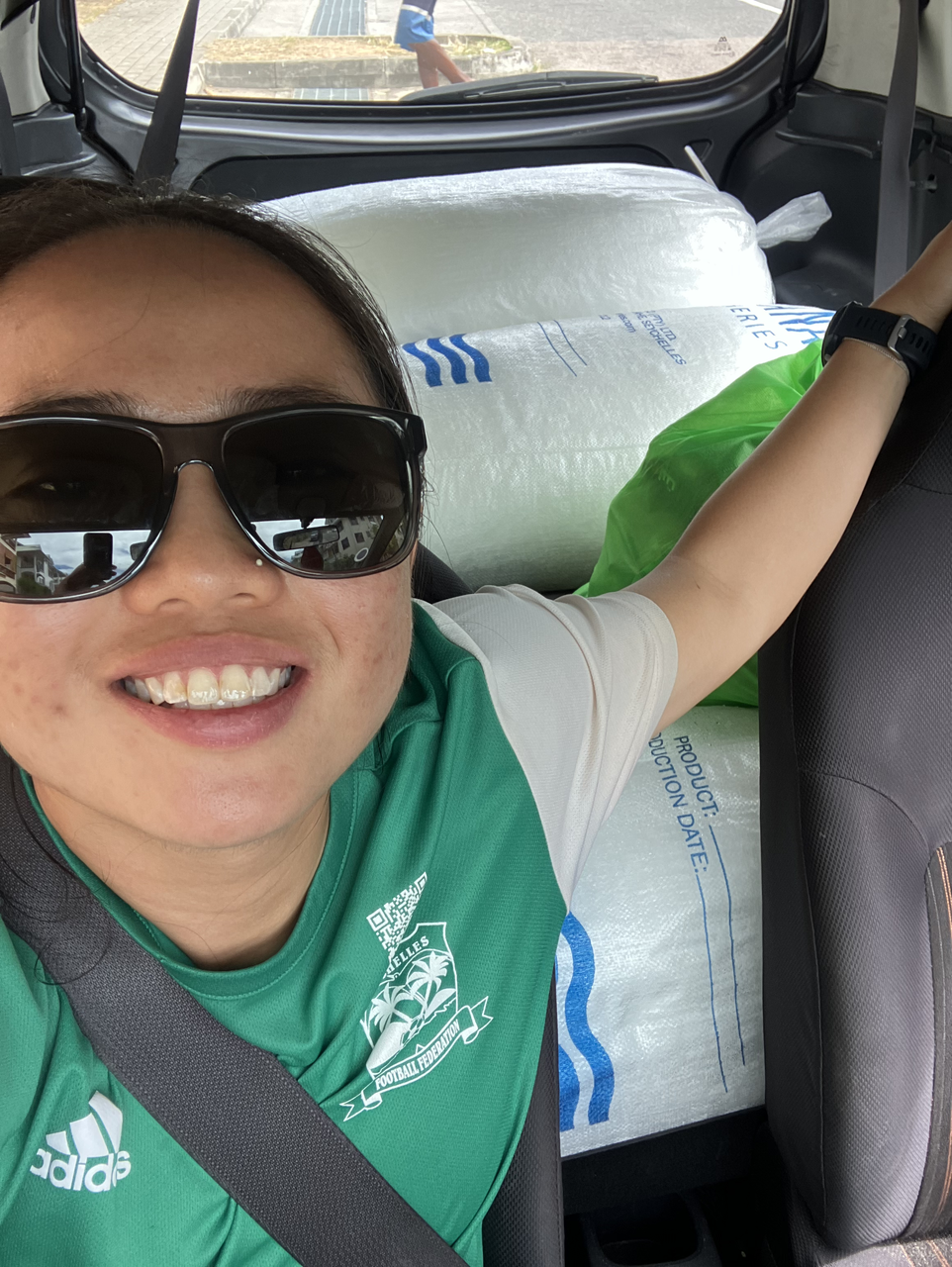
"I had to go to the gym and make sure that I’m strong enough to carry all these things!"
[ How does this compare to the men’s national team setup? ]
Previously, on the men’s side, they have a French technical director (TD), a head coach and a team of staff that they fly in during the FIFA windows (goalkeeper coach, physio, fitness trainer/assistant coach) on top of the local staff consisting of a kit manager and an assistant coach. So, definitely compared to the women, they have more resources. I think things are changing with the new TD.
The deputy TD, a local guy who is here and that is a lot better for communication and frees up a little bit of responsibility from the youth development officer especially, and I have another staff member who, even though some areas might not be his responsibility, helps me whenever he can.
I guess, I feel like people play football for fun and it’s not always taken so seriously, so it’s a bit of a struggle because I want things to move forward but some people don’t want to move so fast. It’s about trying to find a balance.
[ Do you think coming from Singapore (a small country that isn’t a real football ‘powerhouse’) helps you relate to the players/people in Seychelles or helps in another way in this job? ]
I think it's kind of beneficial, because in my time in Singapore, I saw firsthand how women's football grew in different ways, be it in grassroots, the youth national teams, the national teams, the clubs. And I was involved in all of these environments. Coming into this job, I think having some prior experience on how to develop women’s football has been very helpful.
In Singapore, I saw support for women’s football really move forward. I know all the programs that were successful there and I can bring those ideas to Seychelles and adapt it in a way that suits the people here. And, I mean, in Singapore, I was ‘just’ a football coach, I didn’t really have the power to run programs, so it’s been amazing to be in this position and doing all that.
[ How difficult is it to find opponents and schedule matches? (e.g. I saw that the women’s team has rarely entered the qualification groups for the World Cup or the Africa Cup of Nations) ]
For the qualification part, those are things that are out of my control - I mean, it's above my pay grade! That’s more for the directors and the executive committee to decide if we can and should participate.
Anyway, for a country like Seychelles, that is so small, it’s very difficult to find suitable opponents. We can’t really be playing South Africa or Zambia, for example, the standard is too high and we also don’t want to give these girls - who are just starting to get serious about football - such a huge shock. I mean, we want them to stay in the game, we don’t want them to leave the game because of unpleasant experiences.
Unfortunately, most of the time when you're looking for opponents at similar levels, they are kind of like you - in similar environments where there's not enough funding, there aren’t enough girls playing, and as a result, it's very difficult to organize international friendly games with teams of the same standard.
[ The men’s team has a few British-born players in the national team, is finding players abroad with Seychellois ancestry a strategy you’re looking to as well? ]
Yeah, that’s something we want to do - but remember, Seychelles is only 100,000 people, so the diaspora is quite small.
It’s very difficult to make a mark in the world but I’ve been trying to put myself out there in different ways. Like, I really - really - did not want a LinkedIn account, but I needed to put myself and Seychelles football out there and show people that there is football happening here. Because of this, and my constant updating, I have had people reaching out to me with things like, ‘I’m a coach from Canada, I have a player with Seychellois heritage’.
So, we do get some of those messages, but a lot of them are just looking to play youth tournaments or from people who are not really eligible - and from those who are, more often than not, we are kind of a last option.
[ What does success look like in this role? (+ are there specific performance objectives from the FA?) ]
Right now, the objective is not really performance, but really to grow the game, to have more girls playing, and of course, to be sustainable.
For our women’s league, for example, last season, we started preseason with 8 teams and by the start of the season, it dropped to 6 teams and then halfway through the season, another team dropped out - so we ended with 5 teams. Now, starting the new season, we have 8 teams again. Of course, we don’t want teams to be closing down each year, that’s not healthy.
So it’s kind of a roller coaster, and finding ways to be sustainable, to keep the people who are playing active while trying to grow the game and create as many opportunities for girls to play as we can so that we have more and more players.
So, for me, success is really just having more than 300 people playing football.
[ I saw in another interview that you were talking about not wanting football to be the only thing in your life - can you elaborate on this? ]
Well, I have a lot of friends who are in football, but I also have friends who are not in football, right? So I don't want to make it my entire personality because if I talk about football subjects with my non-footballing friends, they won’t understand and that wouldn’t be very considerate of me. But I also feel like a lot of footballers - when football is their entire identity - when they stop football, it’s like, who am I? And I don’t want to have that identity crisis!
There is so much more to life than football, and I think that was very important for me to draw a line. If I’m always thinking about football, I think I’ll burn out. I think that was the reason I felt very tired and fatigued all the time in Singapore, because I was always in that football environment, always switched on. I don’t think that’s healthy for me personally.
When I think back to school, they were always encouraging you to take a contrasting subject. Now, I know that it brings your attention away from the ‘real thing’ and you can relax a little bit and learn something else - I think that’s very important.
For me, football is my work, and sometimes I really want to get away from work. Recently, I saw a video where this lady was talking about how you would introduce yourself if you can’t mention your job. That got me thinking - and for now, I have the answer, because I have separated it - but I think for people who make work their entire identity, they struggle to answer that question.
"There is so much more to life than football, and I think that was very important for me to draw a line"
[ How are you thinking about your future goals? ]
Right now, I am very focused on my work, so the future goals definitely would surround Seychelles. It’s cliche but it is leaving the shirt in a better place. My aspirations would be for football to be sustainable and keep growing in Seychelles.
But personally, going back to my roots as a coach, it’s to improve on my coaching. I am currently on the FIFA Elite Coach Mentorship and having a mentor really helps.
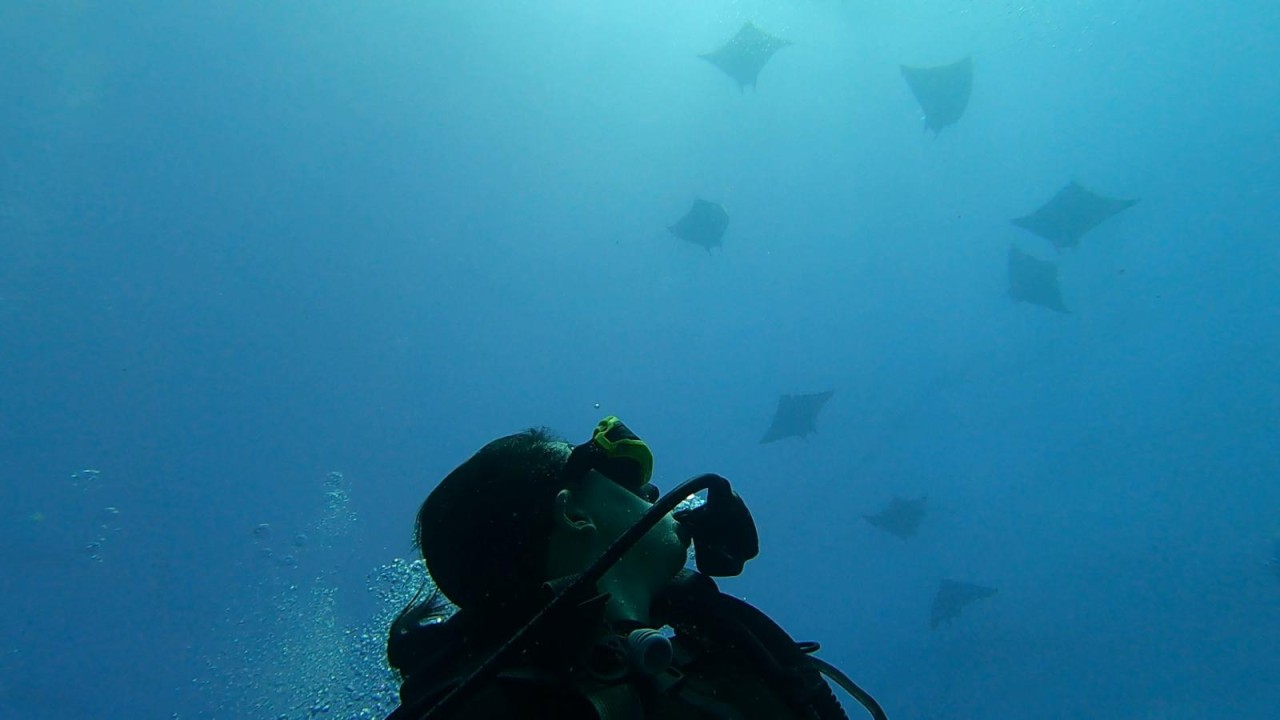
And, outside of football, I hope to become better at diving!